You’ve just found out that you or a loved one has a dust mite allergy, and you’re trying to figure out the best preventive measures. Your first step will probably be creating a healthier sleeping environment. But how do you navigate the options when you can choose between dust mite covers, anti-allergy duvets and pillows?
Should I buy dust mite covers or new duvets and pillows?
Anti-dust mite covers for pillows and duvets are the cheaper but less comfortable option compared to dedicated anti-dust mite pillows and duvets.
Keep in mind that covers go over your pillow and duvet, and then you put your regular bed linen on top. Think of them as a sealable casing for your duvet or pillow — dust mites can’t get out or in, so they can’t breed or accumulate inside.
Maintenance is straightforward: the covers only need washing once or twice a year. If dust builds up, you can vacuum or shake them out from time to time.
What about dust mites on the surface of your bed linen?
You should wash your regular bed linen every two weeks. Allergy sufferers don’t need to worry about the small number of mites that gather on the surface of the covers. Dust mites prefer darkness and warmth, which is why the real problem lies inside bedding — the negligible number on the surface won’t trigger an allergic reaction.
“Anti-allergy” or “hypoallergenic” doesn’t always mean dust mite proof
If you opt for the more comfortable route of duvets and pillows, watch out for products labelled “anti-allergy” that claim to be suitable for allergy sufferers. This doesn’t necessarily mean they protect you from dust mites — it may simply mean they can be washed at 60 °C or above. Similarly, “hypoallergenic” can just mean the pillows and duvets themselves won’t cause an allergic reaction.
Truly dust mite proof duvets and pillows that genuinely protect you must contain a barrier layer that blocks mites and allergens from getting inside, preventing them from accumulating and breeding.
Even if you choose anti-dust mite pillows and duvets, don’t forget that you still need to protect your mattress with an anti-dust mite cover as well.
Nanofibre or microfibre?
The difference is right there in the names: “micro” means small and “nano” means tiny. In numbers, micro is 10−6, while nano is 10−9.
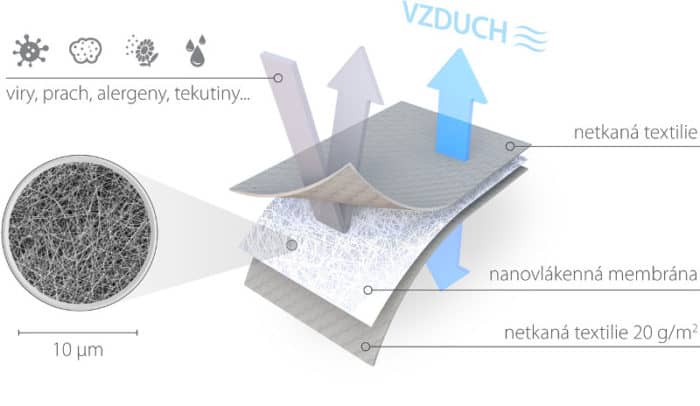
If you weave a fabric from microfibre, its pores will be far larger than those of a fabric spun from nanofibre. That’s why nanofibre products are the clear winner in the fight against dust mites. While microfibre products can stop the mites themselves, allergens (dust mite droppings) pass straight through.
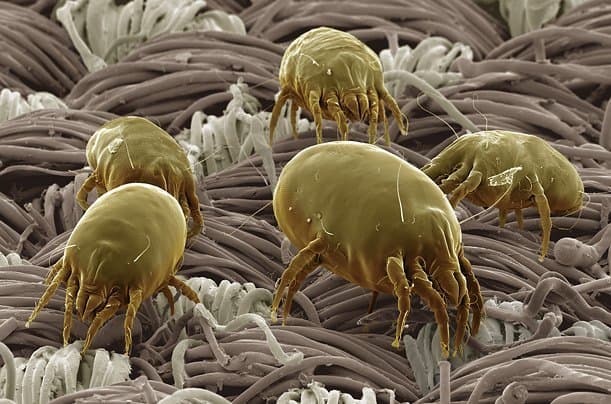
Microfibre products don’t block allergens
Nanofibre products, on the other hand, block allergens with ease. The pores in nanofabric are just 80 nm across. A dust mite measures around 420,000 nm, its allergen is about 1,000 nm, bacteria range from 100 to 10,000 nm, viruses are around 100 nm, and scabies mites about 300,000 nm. None of them stand a chance of getting through.
Picture nanofabric as a football goal net, with an elephant (the mite) and a ball (the allergen) trying to pass through. Neither the elephant nor the ball has any hope of making it.
You might also like: Review: nanoSPACE Anti-Dust Mite Pillow Cover for Allergy Sufferers
Nanofibre bedding is 100% effective and breathable
Many microfibre products use so-called densified microfibre to increase the percentage of mites they catch. The downside? These products tend to be poorly breathable and rustly. Nanofabric products don’t have this problem — an air molecule is just 0.3 nm in size, while nanofabric pores are around 80 nm.
You can also try something different
If you fancy a touch of luxury even when it comes to anti-dust mite bedding, have a look at the latest innovation on the market: bed linen and fitted sheets made from nano-cotton. You won’t need any special covers, duvets, or pillows — this alternative does it all.
The nanofabric layer built into the bed linen itself fully protects allergy sufferers — it’s the most comfortable form of protection available. The downside is a higher upfront cost, and you’ll probably need at least two sets of bed linen and fitted sheets.
Whichever option you choose, you’re on the right track. These products are designed to make life with allergies as easy as possible. Follow our advice — not just here but across our other articles too — and we’re confident your dust mite allergy won’t hold you back.
You might also like: nanoSPACE Review: Year-Round Anti-Dust Mite Complete Bedding Set