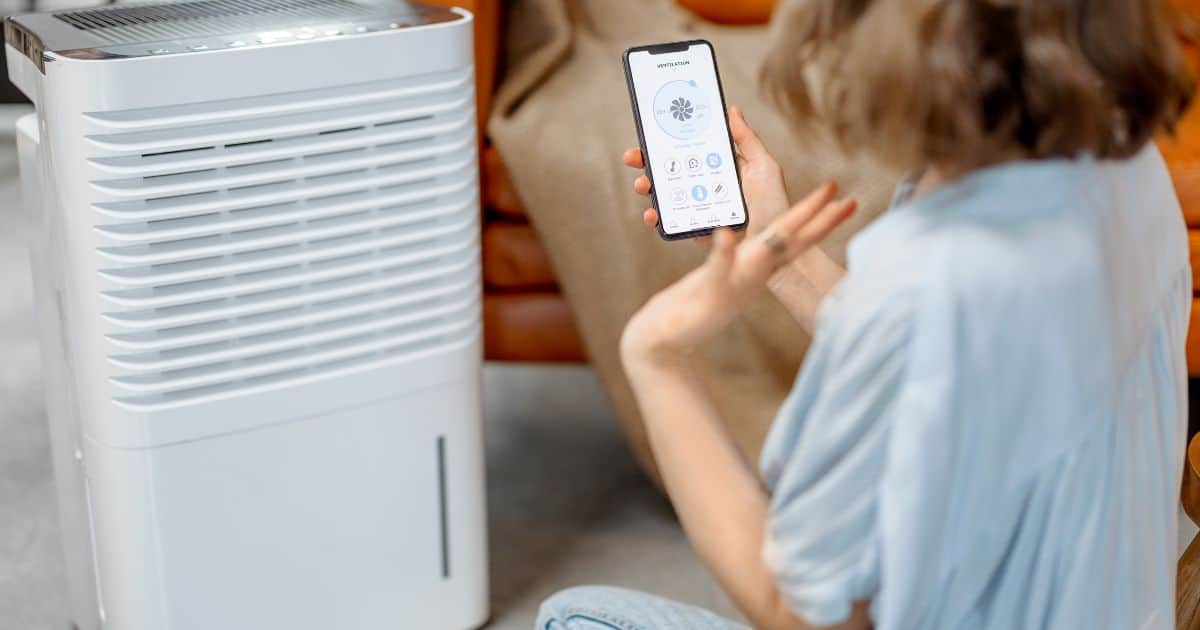
How do you choose a dehumidifier that’s right for you? It’s a question many people wrestle with when they want to improve the air quality in their flat, house, or office. Dehumidifiers have a wide range of uses. Above all, though, they make it easier to fight allergies and other health issues caused by excess humidity. In this article, we’ll explain how dehumidifiers work and how to choose a dehumidifier that fits your specific needs and budget.
What is a dehumidifier for?
A dehumidifier is an electrical appliance designed to regulate humidity levels in homes, offices, basements, or even cars. It has a positive impact on your health — excess moisture can be harmful and lead to a range of unpleasant health problems. On top of encouraging the growth of harmful bacteria and mould, humid air can also leave unsightly marks on your furniture.
Read more about the damage high humidity can cause.
Dehumidifiers: How do they work?
Before we dive into how to choose a dehumidifier, you should know that there are three types of dehumidifiers. They all share the same goal — to reduce indoor humidity to an appropriate level. Each type achieves this in a slightly different way, so let’s take a closer look at all three:
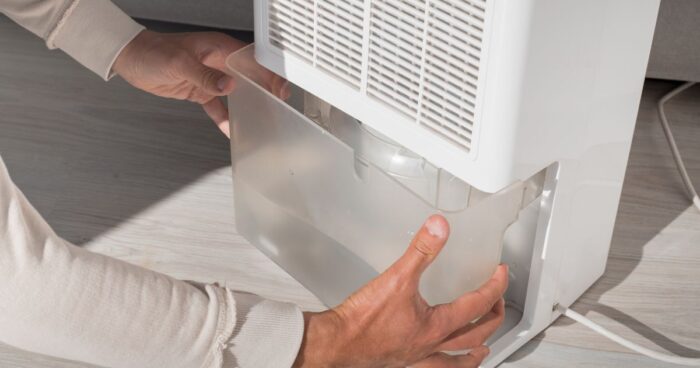
- Compressor (condensation) dehumidifier – This type works by condensing moisture from the air. Air is drawn into the unit, passes through a cooling system, and the moisture turns into water that drips into a collection tank. The dried air is then released back into the room. This process works particularly well in higher temperatures. For cooler environments, the other types are better suited, though they tend to be less energy-efficient.
- Desiccant (adsorption) dehumidifier – This type uses a desiccant material such as calcium sulphate or silica gel to absorb moisture from the air. Once the material is saturated, it needs to be heated so the water evaporates. Desiccant dehumidifiers are ideal for cooler rooms because they’re not limited by temperature range. However, they have higher energy consumption and lower maximum capacity.
- Peltier (thermoelectric) dehumidifier – The last type uses a Peltier element. It contains no compressor and no refrigerant gases. Besides being quiet — making it perfect for bedrooms — it’s also environmentally friendly.
When should you get a dehumidifier?
By now, you’ve probably gathered that a dehumidifier is a genuinely useful appliance that can dramatically improve your quality of life. Since dehumidifiers aren’t the cheapest purchase, let’s look at when it’s worth considering the investment.
- High humidity – If you discover that the humidity in a room exceeds 60%, you may start experiencing health problems, so it’s important to bring it down as quickly and effectively as possible. A dehumidifier is the most convenient way to do that. You can measure humidity with a hygrometer.
- Mould and bacteria – High indoor humidity can encourage mould growth and bacterial proliferation. A dehumidifier helps you get rid of these unwanted organisms — and the unwanted health effects that come with them.
- Allergies – Perhaps you or a loved one suffers from allergies. Damp environments are paradise not only for mould but also for dust mites and other allergens, so without a dehumidifier, allergy symptoms may only get worse.
- Unpleasant odours – High humidity is a common cause of musty smells indoors. The solution isn’t an air freshener — it’s a dehumidifier.
TIP: Mould allergy
8 tips for choosing the best dehumidifier
Unfortunately, there isn’t just one deciding factor when it comes to how to choose a dehumidifier, which makes buying a dehumidifier a bit of a process. Expect to spend some time researching before you buy. To speed things up, here are our top tips on what to look out for.
1) Room size
Start by thinking about the size — and number — of rooms where you need a dehumidifier. This will help you determine the right capacity. The rule is simple: larger rooms require a higher-capacity dehumidifier, while smaller rooms can make do with a lower-powered model. Ask yourself: do I need a dehumidifier for an entire flat, just the bathroom, the kitchen, the bedroom, or the basement?
Most online shops let you filter by room size — for example, nanoSPACE.
2) Room temperature
The average temperature of the room also plays a crucial role in how to choose a dehumidifier. As you now know, compressor dehumidifiers have clearly defined temperature ranges in which they perform best. You’ll probably reach for one of these when dehumidifying a bathroom or kitchen.
A desiccant dehumidifier, on the other hand, is ideal for a basement where it’s much cooler than in living spaces. You could call it the all-rounder — it works well both indoors and in unheated areas, though with higher energy consumption. And the quiet Peltier dehumidifier is best suited for children’s rooms and bedrooms.
3) Capacity
How do you choose a dehumidifier based on capacity? First, it’s important to distinguish between moisture extraction rate and airflow. The moisture extraction rate tells you how many litres of water the dehumidifier can remove from the air within a given time. For small spaces, a rate of 8 to 15 litres is sufficient. Medium-sized rooms need a unit rated at 15 to 30 litres, and for large areas you’ll want a dehumidifier capable of at least 30 to 40 litres.
Airflow, meanwhile, indicates how much air the dehumidifier can process over a given period. The higher the airflow, the faster the humidity drops. That said, there’s no need to go overboard — excessively high airflow can over-dry the air, which may damage your belongings.
Room size is your best guide when choosing a dehumidifier by airflow. As a rule of thumb, the airflow should be roughly three times the volume of the room.
4) Energy consumption
You’ll naturally want to know how much energy a dehumidifier uses. In product specifications, look for the power rating (wattage). The higher the dehumidifier’s capacity, the higher its energy consumption will be. That said, it doesn’t mean smaller, cheaper units always use less power.
5) Tank capacity
Tank capacity is mainly a question of convenience and how much time you have. It determines how often you’ll need to empty the collected water. A larger tank allows the dehumidifier to run longer without needing to be emptied.
6) Noise level
A dehumidifier’s noise level, measured in decibels (dB), affects the comfort of everyone in the room. Fortunately, these days you’ll find plenty of very quiet dehumidifiers suitable even for offices. If you plan to run the dehumidifier overnight, make sure the noise level doesn’t exceed 40 dB.
7) Maintenance
Our list of tips on how to choose a dehumidifier wouldn’t be complete without mentioning maintenance. Weight matters too — perhaps not as much as the previous factors, but it’s still worth considering. Lighter, more compact dehumidifiers are easier to move between rooms and simpler to store.
Don’t overlook whether the dehumidifier has filters that capture impurities, and whether they need regular replacement or cleaning. Honestly, this is something to consider once you’ve narrowed your options down to two or three finalists. If you worried about filter maintenance from the start, you might end up choosing a unit that doesn’t actually meet your primary needs.
8) Special features
Dehumidifiers haven’t escaped the wave of innovation. You’ll find models with Wi-Fi connectivity, allowing you to control settings via a mobile app. Others come with a UV lamp that kills viruses.
One special feature worth highlighting is the combination of a dehumidifier with an air purifier. Not only do you tackle excess moisture, but you also clean the air of allergens, bacteria, and viruses. An ioniser focused on air quality is another worthwhile addition.
How to use a dehumidifier properly
Buying the right dehumidifier is only half the battle — using it correctly is key to getting the most out of it over the long term. Don’t worry, though. Every dehumidifier comes with instructions on how to set it up and operate it. Since every model is different, we won’t try to generalise.
In most cases, you’ll set a target humidity level on the dehumidifier. The ideal indoor humidity should be between 40% and 55%, or 40% to 60% during the winter months.
You might also be interested in: how to get rid of mould
Where to place a dehumidifier?
Place the dehumidifier in the room with excess humidity, making sure there’s enough space around it. Avoid positioning it too close to walls or furniture, as this would restrict airflow.
Key takeaways
There are three types of dehumidifiers on the market, each reducing humidity in a different way. The most important factors when choosing a dehumidifier are the size and temperature of the space where you’ll place it. You should also pay attention to capacity, energy consumption, and noise levels. Your final decision can come down to maintenance requirements or special features. And don’t forget to keep an eye on humidity levels with a hygrometer.
Frequently asked questions
Which dehumidifier is best for a flat?
A compressor (condensation) dehumidifier is a great choice for a flat. It works well in warmer rooms and consumes less energy than the other types.
How much electricity does a dehumidifier use?
Energy consumption depends on the dehumidifier’s capacity. As a general rule, the higher the capacity, the higher the energy consumption.
How often should you run a dehumidifier?
You should run the dehumidifier whenever humidity exceeds 60%. You can monitor levels with a hygrometer.
How do you set up a dehumidifier?
Always follow the manufacturer’s instructions. In most cases, you set a target humidity level. This should be between 40% and 60%.
How long should you dehumidify a room?
Keep the dehumidifier running until the room reaches an optimal humidity level of 40% to 60%.
How do you clean a dehumidifier?
Clean your dehumidifier according to the manufacturer’s instructions that came with the unit.