
A blocked nose can be utterly exhausting — especially when it keeps coming back more often than you’d like. Be honest: are you really doing everything you can to prevent it? You may have already read on our blog that a runny or stuffy nose can be prevented with regular nasal rinsing using a special neti pot. In this article, we’ll look at how a neti pot nasal rinse works and when to use one. I’ll also share which neti pot is the best choice and cover some alternatives in case a neti pot isn’t quite your thing.
TL;DR
- A neti pot mechanically flushes mucus, allergens, and debris from the nose using a gentle stream of saline water.
- The rinse uses an isotonic saline solution (0.9% salt), which you can make at home or buy in pre-measured sachets.
- How often you rinse depends on your needs: up to 3 times a day for acute congestion, once daily for allergy prevention.
- Alternatives include sea-water nasal sprays and special squeeze bottles that work on a similar principle.
- Proper technique and the use of boiled or distilled water are essential for safety and effectiveness.
How does a neti pot work?
A neti pot, sometimes called a nasal irrigation pot, is a traditional tool from Ayurvedic medicine. It’s used for saline nasal rinses — flushing the nasal passages with warm salt water. The principle is purely mechanical: a gentle stream of water enters one nostril, flows around the nasal septum, and exits through the other nostril. Along the way, it carries out everything that doesn’t belong on the mucous membrane — built-up mucus, dust, dried crusts, and most importantly allergens like pollen grains or dust mite droppings.
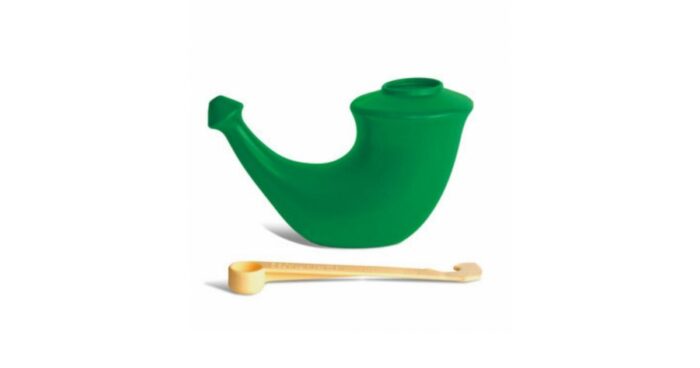
Neti pots are usually made from recyclable plastic or ceramic and have a distinctive shape with a long spout that fits comfortably against the nostril. I know — the idea of pouring water into your nose might sound a bit terrifying. But when you follow the correct technique and use a solution at body temperature, it’s surprisingly pleasant and genuinely relieving.

Benefits of using a neti pot
We’ve already touched on some of the benefits. Let’s take a closer look. Regular nasal rinsing with a neti pot helps with:
Flushing and cleansing the nasal mucosa
A neti pot mechanically rinses the mucous membrane, removing not just mucus but also irritating particles from the environment. As someone with allergies, this is an absolute lifesaver for me after coming home during pollen season.
Improving nasal airflow
Warm saline solution helps thin out thick mucus and clear a blocked nose. The relief is often immediate, letting you finally breathe freely through your nose — which is the foundation for a good night’s sleep.
Supporting your body’s natural defences
A clean, well-functioning mucous membrane is better at fighting off pathogens. The tiny hair-like structures (cilia) on its surface can more effectively move mucus and trapped debris out of the airways. According to some ENT specialists, regular nasal hygiene may help reduce the frequency of respiratory infections.
Moisturising the nasal lining
Nasal rinsing moisturises the mucous membrane, which is particularly helpful in winter — whether you’re spending time in overheated rooms with dry air or out in the cold, both of which dry out the nasal lining.
You might also like: What’s the difference between a cold and allergies?
What to put in a neti pot?
Only ever fill your neti pot with saline solution. Never use plain water — it would osmotically damage the mucous membrane and cause intense stinging. You have two options for preparing the solution.
The first option is to buy pre-mixed sachets. These contain an isotonic solution — a medical-grade product with a precisely measured ratio of sodium chloride and sodium bicarbonate. This ensures the solution has a balanced pH and is as gentle on the mucosa as possible. In my opinion, it’s the ideal choice for beginners because you can be sure the concentration is spot on. A great example is NeilMed Sinus Rinse, which is preservative-free.
The second option is to make the solution at home. It’s cheaper, but it requires precision. You’ll find the exact recipe in the next section.
Homemade saline solution — exact recipe
Making your own solution is easy and economical, but you need to be precise. The wrong concentration can irritate the nasal lining.
Isotonic solution (0.9%) – for everyday hygiene
This is the standard solution for daily preventive rinses. Its salinity matches that of the fluids in your body, so it doesn’t sting at all.
Recipe: Mix 9 grams of salt (ideally non-iodised, without anti-caking agents) with 1 litre of boiled water cooled to body temperature.
Hypertonic solution (up to 3%) – for a blocked nose
This solution is saltier than your body’s fluids. Thanks to the higher osmotic pressure, it helps draw water out of the swollen mucosa and reduce the swelling. It’s excellent for acute congestion or sinusitis but shouldn’t be used long-term, as it can dry out the nasal lining.
Recipe: Mix 20 to 30 grams of salt with 1 litre of boiled and cooled water.
Why add a pinch of baking soda?
You can add about a quarter of a teaspoon of baking soda (sodium bicarbonate) to each litre of solution. The soda acts as a buffer — it stabilises the pH of the solution so it’s closer to the natural pH of the nasal mucosa, making the rinse even gentler.
Safety and sterility matter
Always use water that has been boiled and cooled, or use distilled or bottled water. Don’t use untreated tap water. Although the risk is extremely low in areas with good water treatment, untreated water can harbour the amoeba Naegleria fowleri, which can cause a rare but serious infection. Boiling the water completely eliminates this risk. Store any prepared solution in a clean, sealed container in the fridge and use it within 24 hours.
How to use a neti pot: step by step
Getting the technique right is the key to success. It’ll probably feel a bit awkward at first, but after a few tries it becomes as routine as brushing your teeth. Stand over a sink, lean your head slightly forward, and tilt it to one side. Your chin should point slightly towards your chest so the water doesn’t run down the back of your throat.
Press the spout of the neti pot against the upper nostril and push gently to create a good seal. Breathe calmly through your mouth throughout, and slowly tilt the pot. The water will flow through the nasal cavity by gravity and drain out of the lower nostril.
Once roughly half the solution has passed through, remove the pot. Blow your nose gently to clear any remaining water and mucus. Then tilt your head to the other side and repeat with the remaining solution for the second nostril. Give your nose one final gentle blow when you’re done — no water should be left inside. If you feel like water has trickled into your ear, try tilting your head a little less next time.
After each use, rinse the pot thoroughly with hot water and let it dry completely to prevent bacteria from building up. For a better idea of the technique, watch the video below.
TIP: Nasal rinsing is just as important as brushing your teeth
How often should you rinse your nose?
The frequency depends on your current condition and what you’re trying to achieve. Here’s a simple overview of how often to use a neti pot:
- During acute congestion or sinusitis: The goal here is to clear a blocked nose and flush out as much mucus as possible. You can rinse 2 to 3 times a day, ideally with a hypertonic solution for faster relief from swelling.
- For pollen allergies: To prevent and ease symptoms, rinse once or twice a day. Personally, I always rinse in the evening after getting home to wash allergens off the mucosa that have accumulated during the day — it makes a real difference to my nighttime breathing.
- For chronic rhinitis and sinusitis: Consistency is key here. A rinse once a day is recommended as part of long-term airway care. Always consult your ENT specialist, though.
- As a preventive measure: If you’re healthy but want to boost your defences, rinsing a few times a week or after spending time in a very dusty environment is enough.
A word of caution: Don’t overdo it. Rinsing too frequently (more than 3–4 times a day) could theoretically disrupt the natural protective mucus layer and osmotically damage the mucosal cells. Stick to the recommended frequencies.
Neti pot review
The most widely used and accessible neti pot on the market is undoubtedly the Rhino Horn neti pot. It’s made from sturdy, BPA-free recyclable plastic, is easy to clean, and comes with a measuring spoon that makes preparing the saline solution a breeze.
User feedback is overwhelmingly positive. Reviewers confirm that regular nasal rinsing with this neti pot helps ease congestion symptoms, clear the sinuses, and — for allergy sufferers — provides fast relief. I’ve been using mine for several years and wouldn’t be without it. What I appreciate most is its simplicity and the fact that it’s a completely natural, drug-free method.
The only downside for some people might be that initial feeling of clumsiness while learning the proper technique. But as I mentioned, it’s just a matter of practice. The investment pays for itself through easier breathing and less reliance on nasal decongestant drops — which can actually lead to dependency with long-term use.
How to rinse a child’s nose
Nasal rinsing is a great method for children too, but it does require a bit of patience and a playful approach. Children can usually cooperate from around 4 to 5 years of age. For younger kids, there’s a special Rhino Horn Junior, which is smaller and fits better in their hands — and against their little noses.
The process is the same as for adults, but it’s important to show and explain everything to the child beforehand. You could try it yourself in front of them first, so they can see there’s nothing to worry about. Make sure the solution is at a comfortable body temperature. After the rinse, teach the child to gently blow out any remaining water. If they can’t manage that yet, you can carefully help with a nasal aspirator.
For children, it’s especially important to use precisely mixed isotonic solutions that are guaranteed not to sting. If you’re unsure whether this method is suitable for your child, check with your paediatrician or an allergist.
Nasal rinse without a neti pot — alternatives
What if a neti pot and the gravity-based approach simply aren’t for you? Don’t worry — there are several alternatives that still let you enjoy the benefits of nasal hygiene. The topic of nasal rinsing without a neti pot comes up quite often.
Sea-water nasal sprays
This is the simplest and quickest option. Brands like Sterimar, Physiomer, or Olynth Saline offer nasal sprays with sea water in isotonic or hypertonic concentrations.
Pros: Easy to use, sterile packaging, available at any pharmacy.
Cons: The flow of water is weaker and shorter, so it doesn’t provide as thorough a rinse as a neti pot. It’s more suited to moisturising and lightly cleansing the front part of the nose.
Squeeze bottles (e.g. NeilMed Sinus Rinse)
These are soft plastic bottles with a special nozzle that work by squeezing. You control the strength of the flow yourself.
Pros: Allows a more thorough rinse than a spray, and the water flow is gentle and steady. Some people find it more intuitive than the passive flow from a neti pot.
Cons: Requires regular, thorough cleaning to prevent bacteria from building up inside the bottle.
Bulb syringes and syringes for children
For the youngest children who can’t cooperate yet, saline solution is sometimes applied using a syringe (without a needle!) or a rubber bulb syringe. The aim is mainly to moisten and thin the mucus, which is then suctioned out. However, always consult your paediatrician about this method, as incorrect pressure can push mucus into the middle ear.
You might also like: How do nasal drops work and which ones are best?
💧 What I use during peak pollen season
I personally use a combination: a neti pot with saline in the morning, an occasional nasal spray from nanoSPACE during the day, and a nano respirator outdoors when pollen counts peak. The combination gives me the greatest relief.
Conclusion
A neti pot isn’t a miracle cure, but it is an incredibly effective and simple tool for looking after your airways. Whether you’re struggling with frequent colds, chronic rhinitis, or pollen allergies like me, regular saline nasal rinses can bring enormous relief. By flushing away debris and allergens, you support the natural function of the nasal mucosa and clear a blocked nose without unnecessary chemicals.
If you haven’t tried it yet, give it a go. You might be surprised at what a big difference such a small change in your daily routine can make. Start with just one rinse in the evening and notice how much better you breathe in the morning. It’s a small step for you, but a giant leap for your nose. And if a neti pot doesn’t suit you, remember there are other ways to give your nose the care it needs.
Frequently asked questions
How do you rinse your sinuses?
Sinus rinsing is straightforward. Prepare a salt-and-water solution according to the instructions. Tilt your head over a sink and place the spout of your Rhino Horn neti pot into one nostril. Slowly tilt the pot so the liquid flows through the nose and drains out of the other nostril. Repeat on the other side, then gently blow your nose.
What salt should you use in a neti pot?
Ideally, use pre-mixed saline solution sachets that guarantee the correct concentration and pH. If you’re mixing the solution at home, use pure non-iodised salt (sea salt or Himalayan salt) with no added ingredients. Regular table salt may contain anti-caking agents that could irritate the nasal lining.
How often can I rinse my nose with a neti pot?
For everyday hygiene and prevention, once a day is sufficient. During acute congestion, sinusitis, or heavy pollen season, you can increase the frequency to 2 to 3 times a day. Always listen to your body, and if in doubt, consult your doctor.
How quickly does a neti pot help?
Mechanical relief from a blocked nose and a feeling of easier breathing comes almost immediately after a rinse. The soothing, anti-inflammatory effect on the mucosa becomes noticeable within a few days of regular use.
Can a neti pot be harmful?
When used correctly, this method is very safe. The risks come from using non-sterile water (always boil it first!) or an incorrect salt concentration, which can irritate the mucosa. People with swallowing disorders or neuromuscular conditions should consult a doctor before using one.
From what age can children use a neti pot?
It’s generally recommended to start around 4 to 5 years of age, when a child is able to cooperate, breathe through their mouth, and blow their nose gently. Always use a special children’s neti pot and supervise the rinse. For younger children, always consult your paediatrician.
Can I rinse my nose in the shower instead?
This isn’t recommended. In the shower, you have no control over salt concentration (the water isn’t saline) or water pressure. Plain water would severely irritate the mucosa, and a strong jet could cause pain or push infection deeper into the sinuses.
Why does my nose sting after rinsing?
The most common cause is an incorrectly mixed solution — either too much or too little salt. Stinging can also be caused by water that’s too cold or too hot. Always make sure the solution is at a comfortable body temperature.