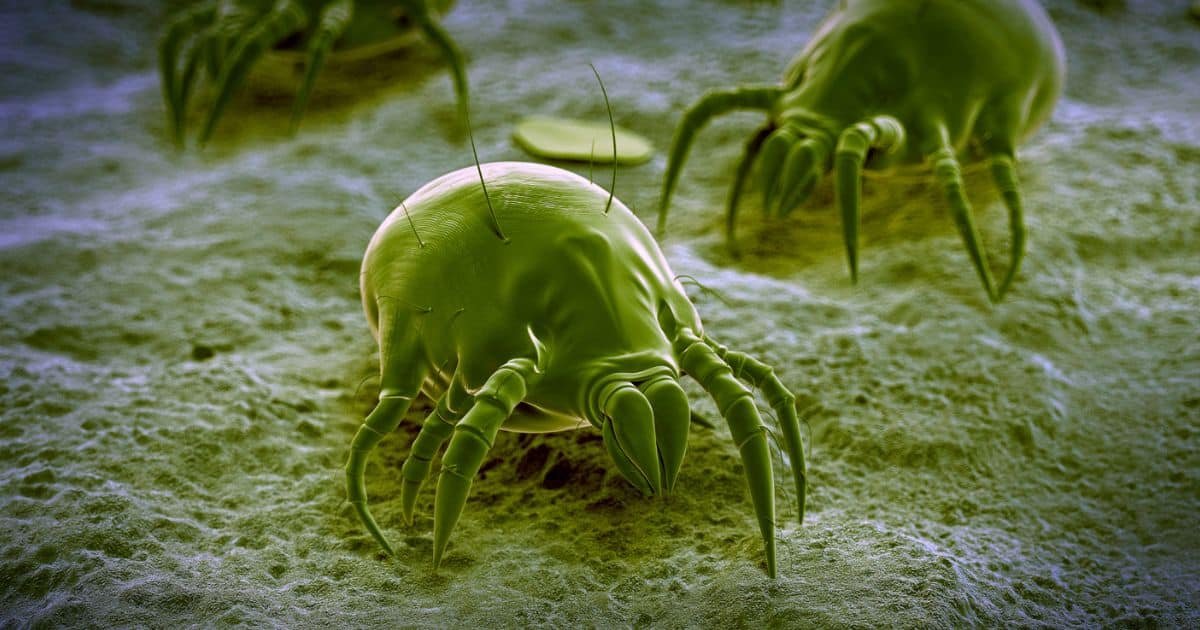
Dust mite allergy affects a growing number of people — but do you actually know what causes it? Sure, you might say “dust mites.” But why do these microscopic creatures we can’t even see have such a profound impact on our health? In this article, we’ll take a detailed look at what is a dust mite, what problems they cause, and — most importantly — why.
TL;DR
- Dust mites aren’t insects — they’re microscopic arachnids found in every home, especially in beds, carpets, and upholstered furniture.
- The allergy isn’t caused by the mites themselves but by their droppings, which contain aggressive enzymes (mainly the allergen Der p 1) that damage our mucous membranes.
- Humidity is the key to their survival. Below 50% relative humidity they begin to die off, making humidity control essential.
- A typical mattress can harbour anywhere from 100,000 to 10 million dust mites that feed on our dead skin cells.
- Effective defence combines anti-mite bedding covers, washing at 60 °C, regular cleaning, and maintaining optimal indoor humidity.
Question of the day: What is a dust mite?
Let’s set the record straight from the start. A dust mite is not an insect. It belongs to the arachnid family, just like spiders and ticks. These are microscopic creatures so tiny (averaging just 0.2 to 0.3 millimetres) that you have no chance of spotting them with the naked eye — you’d need a microscope. Their body, technically called an idiosoma, doesn’t have a separate head and thorax like insects do. Adults have eight legs equipped with suction pads that let them cling firmly to fibres in your mattress or carpet, which means you can’t simply vacuum them away. They have no eyes or antennae and navigate solely using sensitive hairs on their body.
Although countless species exist, the one that matters most to allergy sufferers is the house dust mite, an inseparable part of the dust in our homes. Don’t worry — you’re not alone in this. Absolutely everyone has dust mites at home. The trouble only starts when their numbers explode and their allergens begin irritating your immune system.
Main dust mite species
When we talk about “dust mites” in general, we’re actually dealing with several specific species in our homes. Knowing which ones are most common helps explain why your allergy may worsen under different conditions. The most frequently encountered dust mite species include:
Dermatophagoides pteronyssinus (European house dust mite)
This is the dominant species, making up roughly 60% of the dust mite population in homes. Its name Dermatophagoides means “skin eater.” It thrives in the mild, relatively humid climate found across much of Europe.
Dermatophagoides farinae (American house dust mite)
The second most common species, accounting for about 30% of the population. It’s more resilient in drier environments because it can enter a dormant stage (diapause) when humidity drops. That’s why it’s more prevalent in areas with a continental climate, where heavy indoor heating in winter makes the air much drier.
Euroglyphus maynei
This species often appears alongside D. pteronyssinus but requires even higher humidity. Its allergens are very similar to those of the Dermatophagoides genus, which means they cause cross-reactivity.
Less common species
Occasionally you may come across Blomia tropicalis, a species typical of the tropics that can turn up in temperate regions too, thanks to global travel and climate change. There’s also an entire group of so-called storage mites, which we’ll cover in more detail later.
Life cycle and reproduction
Understanding how dust mites reproduce is crucial for fighting them effectively. The entire dust mite life cycle is fascinating — and, unfortunately for allergy sufferers, remarkably fast. Under optimal conditions (around 25 °C and 75% relative humidity), development from egg to adult takes just 3 to 4 weeks.
The cycle unfolds in five stages:
- Egg: A female lays 60 to 100 eggs during her lifetime. She deposits them deep inside the mattress or carpet where they’re protected. Development takes about 8 days.
- Larva: A six-legged larva hatches from the egg and immediately starts feeding. This stage lasts roughly 6 days.
- Protonymph: After its first moult, the larva becomes a protonymph with eight legs. This phase lasts about 4 days.
- Tritonymph: Another moult produces the tritonymph stage, lasting a further 4 days.
- Adult: After the final moult, the adult mite emerges and lives for approximately 2 months. Its main purpose is feeding and breeding.
A single adult dust mite produces around 20 faecal pellets per day. Over its lifetime, that adds up to about 2,000 of these microscopic allergen-packed “parcels.” Multiply that by the millions of mites in a single bed and it’s clear where that massive allergen load comes from.
What dust mites eat — why your bed is their paradise
For dust mites, your bed isn’t just a hiding place — it’s a five-star all-inclusive resort. It offers everything they need to survive: warmth, darkness, humidity, and an unlimited food supply. Their primary food source is our dead skin cells. Every day we shed roughly 1.5 grams of skin flakes, which is more than enough to sustain a population of millions (Korsgaard, 1998).
Our skin on its own, however, is hard for dust mites to digest. That’s where their little helpers come in — microscopic fungi (moulds) such as Aspergillus penicillioides that grow on skin flakes inside the mattress. These fungi first break down the fats in the skin, and the mites then consume this “pre-digested” meal. As a result, a typical mattress can host anywhere from 100,000 to 10 million dust mites. I know that number is pretty terrifying, but it’s a reality we need to learn to deal with.
Humidity — a matter of life and death
Relative humidity (RH) is the single most critical factor for dust mite survival. They don’t drink water in the conventional sense — instead, they absorb it from the surrounding air through specialised glands. This mechanism only works when the humidity is high enough.
The critical threshold for their survival sits around 73% RH. When humidity drops below 50%, mites start losing water faster than they can absorb it, gradually dehydrating. Below 40%, massive die-offs occur within days. Conversely, humidity above 75% triggers explosive population growth.
This also explains the seasonal pattern of my symptoms — and probably yours too. In late summer and autumn, when outdoor humidity is high, dust mite populations peak. In winter, once the heating comes on, indoor air dries out dramatically, often dropping below 40% RH. Mites die off in droves. Paradoxically, though, allergy symptoms can actually worsen. Dead mite bodies break apart and release enormous amounts of allergens into the dry air, which swirls around easily in unventilated rooms.
What problems do dust mites cause?
Dust mites can cause a wide range of problems, particularly for sensitive individuals. Inhaling allergens from their droppings and body fragments can trigger strong allergic reactions. In some people, mites can also provoke asthma symptoms or worsen existing asthma. If you wake up in the morning with a blocked nose, sneezing, or itchy eyes, there’s a very good chance dust mites are to blame.
Dust mite allergy
Dust mite allergy is one of the most common allergies of all. When someone with this allergy comes into contact with mite allergens, the immune system launches an exaggerated defensive response. This leads to typical symptoms such as chronic rhinitis, conjunctivitis, atopic eczema, an irritating cough, breathing difficulties, poor sleep quality, and chronic fatigue. If you suspect you might be affected, I’d strongly recommend visiting an allergist for the appropriate tests.
Asthma
For asthma sufferers, the presence of dust mites is particularly dangerous. Studies have demonstrated a direct link between high concentrations of dust mite allergens during childhood and the development of asthma. A study published in the New England Journal of Medicine showed that children exposed in their first year of life to allergen concentrations above 10 µg/g of dust had nearly five times the risk of developing asthma by age 11 (Sporik et al., 1990). The allergens irritate the airways and can trigger attacks of breathlessness.

Allergens — Der p 1, Der p 2, and Der p 23
To understand why dust mites are such a problem, we need to look at their “weapons” — allergens. These aren’t just passive particles; they’re highly active proteins, mostly enzymes. When they land on our mucous membranes, they actively break down the tissue and open a path to our immune cells.
Der p 1: The mucosal barrier destroyer
This is the main and most aggressive allergen. Der p 1 is a digestive enzyme (cysteine protease) found in high concentrations in dust mite droppings. Its function is to break down proteins. When we inhale it, it literally “snips apart” the junctions between cells in our mucous membranes. This breaches the protective barrier and allows other allergens to penetrate deeper into the body, triggering inflammation. More than 80% of people allergic to dust mites have antibodies against Der p 1.
Der p 2: A false alarm for the immune system
Der p 2 works differently. Its shape mimics a molecule that normally signals a bacterial infection in our bodies. When it binds to receptors on immune cells (TLR4), it triggers a false alarm. The immune system thinks it’s fighting bacteria and mounts a powerful inflammatory response — even though there’s no real threat.
Der p 23: The hidden threat for asthma sufferers
This allergen was discovered relatively recently. It’s part of the coating that holds faecal pellets together. Studies have shown that sensitivity to Der p 23 is strongly linked to asthma severity. Patients with antibodies against this allergen often experience a more severe course of the disease. Awareness of these components is important for modern allergy diagnostics.
Storage mites — from the barn to occupational asthma
Besides house dust mites, there’s a group known as storage mites, including species like Acarus siro and Glycyphagus domesticus. As the name suggests, their home isn’t your bed but granaries, grain stores, bakeries, and barns. They feed on flour, grain, and moulds.
These mites are primarily encountered by people in certain occupations — farmers, bakers, and millers. Inhaling large quantities of their allergens can lead to occupational asthma, commonly known as “baker’s asthma.” Although they’re different species, their allergens are partly similar to those of house dust mites, which means cross-reactivity can occur.
Climate change and the spread of dust mites
Unfortunately, the outlook for allergy sufferers isn’t rosy. Two factors are playing right into the mites’ hands: climate change and modern housing. Global warming and milder winters mean the usual winter population crash is less pronounced. Dust mites are also spreading to higher altitudes where they previously couldn’t survive. While the threshold used to be around 1,200 m above sea level, they’re now commonly found up to 1,500 m.
The second factor is our homes. The push for energy efficiency has led to widespread insulation and airtight double-glazed windows. Our flats and houses have become almost hermetically sealed. Moisture from cooking, showering, and breathing has nowhere to escape, and unless we ventilate regularly and properly, we’re creating a year-round paradise for dust mites with ideal humidity levels. According to some projections, the prevalence of dust mite allergy could rise from 25% (in 2020) to as much as 35% of the population by 2030.
What dust mites hate: How to get rid of them
Now you know what you’re up against. The good news? Once you understand your enemy, you can fight back effectively. The goal isn’t to eradicate dust mites entirely — that’s impossible. The aim is to reduce their numbers and the allergen load below the threshold that triggers your symptoms. It all comes down to prevention and regular cleaning.
Your first step should definitely be investing in anti-dust-mite bedding covers. Special encasings for your mattress, pillow, and duvet with a nanofibre membrane act as a perfect barrier. Mites and their allergens stay trapped inside the bedding and can’t reach you. I personally swear by them — the difference in sleep quality was noticeable straight away.

Don’t forget to wash your regular bed linen every 1–2 weeks at 60 °C. This temperature reliably kills dust mites. It’s also important to keep indoor humidity below 50%. Regular ventilation or a dehumidifier can help with that. And of course, regular vacuuming with a quality HEPA-filter vacuum cleaner and damp-dusting are absolute basics.
Read our detailed guide on how to get rid of dust mites.
🔬 Home testing and monitoring
To get an idea of how many dust mites you have at home, try the Acarex test (~400 Kč). For a long-term solution: nanofibre bedding covers + humidity control with a dehumidifier.
📖 You might also be interested in
Conclusion
Dust mites may be invisible, but their impact on our health is very real. I understand how frustrating it can be to fight something you can’t even see. The key to success, though, is understanding their biology. Once you know they need humidity and food, you can simply disrupt those conditions. It’s not about keeping a sterile home — it’s about smart, targeted measures.
If allergy symptoms are bothering you, don’t brush them off. Start with the simplest step — focus on your bedroom. That’s where we spend a third of our lives, and it’s where allergen concentrations are highest. Investing in quality anti-dust-mite covers pays off with calmer sleep and better mornings. And remember: if you suspect you have an allergy, seeing an allergist is always the right first step.
Frequently asked questions
How big is a dust mite?
A house dust mite is microscopic, measuring on average just 0.2 to 0.3 millimetres (200–300 micrometres). It’s invisible to the naked eye — you’d need a microscope to see one.
How many dust mites live in a mattress?
The number varies depending on the age of the mattress, humidity, and hygiene, but a typical used mattress can harbour anywhere from 100,000 to several million dust mites. That’s why protecting your mattress with an anti-mite encasing is so important.
Do dust mites bite?
No, house dust mites don’t bite or suck blood. Allergic reactions are caused by the proteins in their droppings and body fragments that we inhale. If you have bites on your body, the culprit is something else — such as bed bugs or fleas.
How can I tell dust mites apart from other insects?
You can’t distinguish dust mites from insects with the naked eye because mites are invisible. Insects like bed bugs, fleas, or lice are visible. Another key difference is that dust mites don’t cause bites — they trigger respiratory and skin allergies.
What conditions kill dust mites?
Dust mites die under extreme conditions. They can’t survive in dry environments with relative humidity below 40%, at temperatures above 60 °C (hence washing at high temperatures), in direct UV sunlight, or in freezing temperatures.
What are the typical symptoms of dust mite allergy?
Dust mite allergy most commonly manifests as rhinitis (a blocked nose upon waking), sneezing, conjunctivitis, eczema, coughing, breathing difficulties, poor sleep quality, and fatigue.
How often should I vacuum to minimise dust mites?
We recommend vacuuming floors and carpets at least twice a week, ideally with a vacuum cleaner fitted with a quality HEPA filter that traps even the smallest allergens instead of blowing them back into the air.
Are dust mites dangerous for children?
Dust mites can trigger allergic reactions in children too, and early, high exposure to their allergens is a risk factor for developing asthma. Following anti-dust-mite measures is therefore especially important for children with allergies.